
Something Left Behind
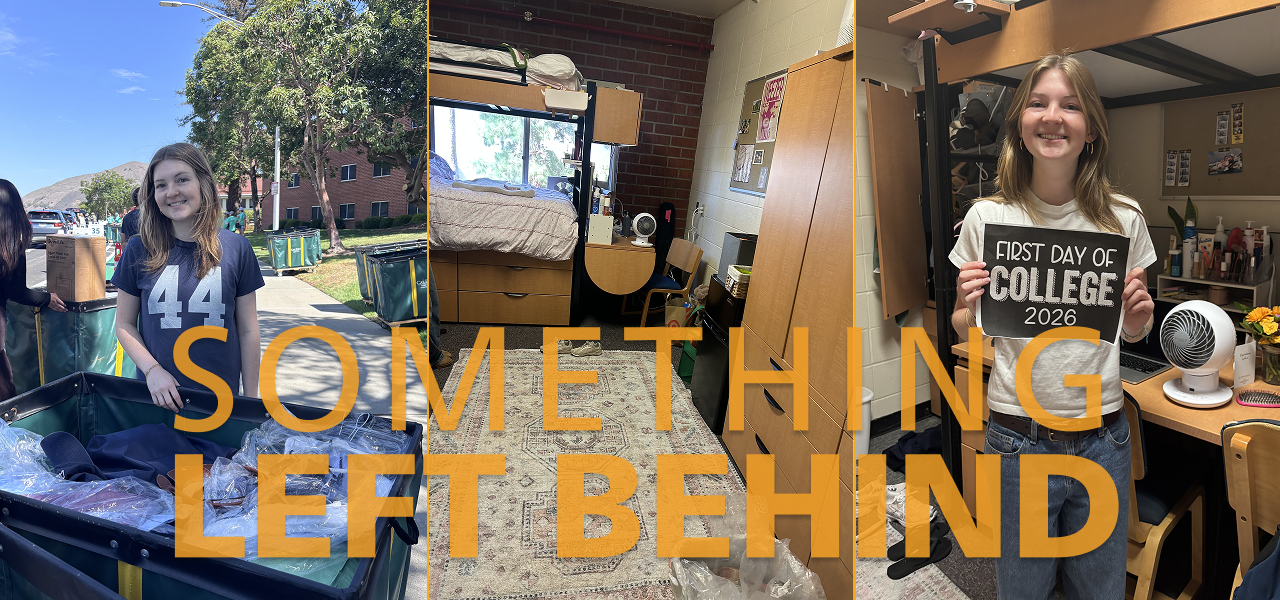
The drive to her college took two days, fourteen hours of highway, three of us in the car, no particular hurry to get there.
It gave us time to just be a family. We stopped for lunch and dinner, took turns on the playlist, talked about the past and a what was coming. When "Party in the USA" came on, all three of us sang. It's become our family anthem. It's been on every car ride we've taken and every trip through Europe. "You were only two or three when this came out," I told my daughter, "and it's still one of your favorite songs."
I looked in the rearview mirror and saw the little girl on her way to camp. I looked again and saw the eighteen-year-old looking back at me. Both of them were in there, and I didn't get to choose.
Three of us were driving. Only two of us would drive back.
My son, my daughter's twin, stayed home with the dogs. He leaves for college himself later this month.
Move-in was bins and boxes and a hallway full of families doing the same thing at the same time. We stayed until there was nothing left to carry up.
"Instead of dragging goodbyes out, let's just say goodbye after we're done moving in."
That was her request, and we understood it. No text from the road, no call from the hotel, no FaceTime from a gas station somewhere. It felt final. It also made sense. She wanted to go back up to her room, be with her new roommates, and go to dinner with them. She wanted to start her life there instead of spending the evening finishing ours. So we hugged her, turned around, and walked to the car.
Then the hotel. Then the long way home.
September always feels like this, endings and beginnings stacked on top of each other. The end of summer, the start of school, the last of the carefree days and the first of the new responsibilities. Your body knows before your mind does. I've felt it every year of my life. I had just never felt it in a car with an empty seat in it.
We didn't only leave our daughter behind. We left behind a version of our family that doesn't exist anymore.
Nothing catastrophic happened. Everything happened exactly as it was supposed to. And something still ended.
You Don't Need to Be Ready
"Maybe I should take a gap year."
"What if I worked this year and took classes at community college instead?"
Every family I know has some version of this conversation in the last weeks of August. We had ours. We took each question seriously and followed it all the way to the end. What the year would actually look like, what she'd be doing in March, where she'd be the following September.
What we kept coming back to was a distinction. A gap year you take because there's something you're burning to go do is one thing. A gap year you take because the other option frightens you is just the same fear with a year added to it.
So the answer stayed the same. Go.
Fear makes us think and do crazy things. It's in our DNA, and it believes it's helping. It wants us safe, comfortable, and still. So it tells us we're not ready. That we don't have the skills. That everyone else is better prepared and smarter than we are.
And you know what? Sometimes that's true. Sometimes everyone else really is more prepared than you.
You go anyway. You go scared.
That was our message, over and over. You will rise to it. Not because you're ready, but because rising is what happens after you go.
All the big things arrive before we're ready. Marriage, kids, the job, college. You can prepare and study and plan and do everything to get set, but at some point the preparation runs out and the only thing left is the leap.
In my book A Field Guide to Creativity, I write about the frog who wants a bigger pond. There's no bridge to it. There's the leap, and there's the lily pad. From where the frog is sitting, there's no way to know whether that pad will hold him, or whether it's even there.
In my experience, it usually is. Not because the universe owes anyone a soft landing, but because the leap itself changes what's available to you. You can't see the next pad until you're already in the air.
She got in the car. She carried the boxes up. She went anyway.
You don't need to be ready.
You need to go.
And if you're scared, YOU DO IT SCARED.
Who Am I If I'm No Longer Needed
This feeling isn't new to me. I didn't wake up on college move-in day and suddenly discover I was no longer needed. That had already happened years earlier, and it was devastating.
It happened on Halloween, which is normally my favorite time of the year.
Every year since the twins were born we went out together. The first year we dressed them as lions and took them to a few select houses in the neighborhood, since it was cold and rainy. My love of the season seeped into them fast. Every September we'd start in earnest on costumes. They picked the theme, and then I'd sketch and revise and research. I built Pinterest boards. I found cloth samples and props. We made the costumes together, and I could not have been happier.
The ritual lasted from kindergarten through ninth grade.
I knew it was ending. There's that awkward stretch where teenagers get too self-conscious, too aware that they aren't kids anymore and maybe shouldn't be excited about this. Mine lasted longer than most, probably because I'm a big kid myself and my enthusiasm buoyed theirs. I was lucky to get as long as I did.
Tenth grade was the first year without it. The sadness started in September. I could feel it coming on like a receding beach before a tidal wave.
By then my son was putting together his own costume. Teen appropriate. Some effort, but not so much that it would seem cringe. He was going to a party with friends instead of coming with us or going to a family get-together.
I sat on the couch watching Young Frankenstein, waiting for trick-or-treaters. My son, who is very empathetic, sat down next to me before he headed out.
"What's wrong, dad?"
I told him. I said I felt an overwhelming sense of loss, that his and his sister's childhood was over, and that the specific father-and-child thing the three of us had was ending. I told him I missed walking the neighborhood with them, the leaves coming down, the cold air, the whole street alive with kids and laughing. I also told him I was happy for him, glad he had a new life of teenage experiences ahead, and that having a life on his own terms mattered.
He said he understood, and that he felt some of it too. He could tell things were changing, and leaving childhood things behind was hard. We hugged. He left for his party. I watched my movie and handed out candy to a very meager crowd of trick-or-treaters.
It was going to be okay.
Around ten o'clock, my son came home.
I asked why he was back so early and how the party was. He sat back down next to me. The party was fine, he said. The people were nice, his friends were good, nobody was really dressed up, they talked and had snacks. All perfectly appropriate, adult things to do at a party.
It just had none of the fun.
So we sat there and talked about what Halloween used to be. Being a kid with his friends, playing in someone's backyard in costume. How I'd BBQ huge plates of hot dogs and sausages and let them ravage the food and eat however boys want to eat. All the dads over with their sons, everybody sweaty from the trampoline, then out into the neighborhood like little heathens, house to house, running into classmates and their little brothers and sisters in the street.
I told him Halloween would stay fun, and that some of the best ones were still ahead of him, in college and in his twenties in some city.
I don't know if he believed me. I'm not sure I did either.
We sat there a while longer and watched black and white horror movies from the fifties. It was really nice.
That was the night I stopped being the dad I had been. Somewhere between October 31st and November 1st, I became a different kind of father.
Before that, I knew exactly what kind of father I wanted to be. And I was him. I did it the way I believed it was supposed to be done.
I have no clue what this new one is. I'm making it up as I go.
But I'm living by example now. Taking risks, and picking up the pieces after a failure where my kids can watch me do it.
Your children aren't the only ones being asked to become somebody new.
I'm still needed. I'm just being asked to become someone new, too.
The Year I Answered the Call (Except for the One Part That Scared Me)
A year ago I was let go from my job as creative director at a start-up.
It wasn't the first time this has happened, and honestly it may not be the last. I typically roll with these punches as they come. I'm stunned and dejected for about twenty-four hours, then I pick up the pieces and I'm ready to go. Monday was the day I got my notice. By Tuesday I had already formulated my plan.
What I didn't understand at the time was that I'd spend the next twelve months doing almost everything my new life required of me, and carefully avoiding the one thing that actually scared me.
The call to adventure
In the hero's journey, it all starts with the call to adventure. Something within and without sends a signal to your brain that it's time to go. Time to get started.
We all hear that clarion call, and we hear it throughout our lives. We experience the hero's journey again and again. It takes us from home to kindergarten, from grade school to middle school. We leave our homes. We leave our jobs. We get married. We start that creative project. We begin something new that we're called to do.
I love that part. It's exciting, and it holds something in it for all of us. It's what every good story starts with. And your life should be, among all else, a good story.
But that's not the part that interests me
What I find interesting is the first instinct to refuse it.
I'm not talking about Odysseus, or Luke Skywalker, or Katniss Everdeen. I like those heroes as much as the next person. What I'm interested in is you. Real people in the real world, making decisions, trying to live a life of meaning and value and purpose.
And when I ask this question, I'm really trying to answer it for myself. Why do I hesitate? What do I fear? Why won't I do what's being asked of me?
The easy answer is fear of change, fear of risk. That's true, and it's also too general to be useful. People hate change. Humans hate risk. Fine. It doesn't explain why this particular thing, the one specific step, is the one I keep walking around.
The hero's understanding of his own size
Here's what I think is closer to the truth, at least for me.
The refusal isn't only a fear of failing. It's a fear of finding out how big you actually are.
If you never take the step, you never learn your true potential, and there's a strange safety in that. Because if you turn out to be smaller than the story you've been telling yourself, that's a disappointment you have to live with. And if you turn out to be bigger, that's worse in its own way. Then you have to go be that person. You have to rearrange your life around a self you've only theorized about. The comfortable version ends.
Not knowing your size keeps you exactly where you are. And where you are is usually held in place by good things: family, friends, people you love, a life you built on purpose. The comfort zone isn't a prison. That's what makes it so hard to leave.
A lens for your own life
I use the hero's journey, the monomyth, as a lens to understand my own choices and actions, and then to help the people I come into contact with.
It turns out this isn't just a nice idea. Research published in the Journal of Personality and Social Psychology found that people who frame their life story as a hero's journey report significantly more meaning in life, and that you can teach someone to do it. Participants who were guided through "restorying" their own lives in that structure showed measurable increases in meaning and resilience afterward.
That tracks with everything I've experienced. When you see yourself as the protagonist of your own story, failures and setbacks stop being verdicts and start being chapters.
And the most powerful part of the hero's journey as a metaphor for our own lives is this: what's happening externally is mirrored by what's happening internally. As we grow and change physically and mentally, we're growing and changing spiritually to match.
What I did with my year
I heard a clear call to adventure and I got started in earnest and with fire. I knew what I wanted to do because I'd been thinking about it for years. I had written down every thought I ever had on creativity, every workshop idea, every book idea, every product I ever had a crazy idea about.
Here's a short (very short) list of what I did in those first weeks:
Reworked my résumé and professional positioning
Rebuilt and strengthened my LinkedIn presence
Refreshed my personal website
Established a more consistent social media practice
Started sharing my ideas publicly around creativity, identity, storytelling, and meaningful work
Created a new vision board for my life and career
Wrote a personal manifesto
Developed a business plan around my creative ideas
Established a clear five-year vision for building a significant creative enterprise
And here's what came out of the year that followed:
Returned seriously to writing my book
Consolidated years of stories, creative philosophies, exercises, lessons, and personal experiences
Won a publishing deal by November 2025
Expanded Identity by Design into a complete college-level course
Created Identity by Design: Building a Personal Brand Through Story, Strategy, and Craft
Developed it as a sixteen-week, four-credit graphic design course
Developed a fifty-two-card creativity prompt deck
Clarified my speaking topics around creativity, identity, storytelling, and meaningful experiences
I thought I had done everything under the sun to chase down my dreams.
The most sophisticated way to refuse the call
Read that list again, though, and notice what isn't on it.
Every single item is real work. None of it is procrastination. I wasn't avoiding my calling. I was executing on it, hard, for a year. But I was executing on it in every direction except the one that frightened me.
That's what I've come to understand about the refusal of the call. It rarely looks like refusal. It almost never looks like sitting still. For ambitious people it usually looks like tremendous, visible, genuinely valuable productivity that happens to route carefully around a single point.
The vision board was easier than the camera. The business plan was easier than the camera. A sixteen-week course was easier than the camera.
Because the last part of the call was video. A YouTube channel. Me making my own videos. My own voice, just talking about my ideas, sharing something that felt personal and intrusive, and that I dreaded with all my heart.
So I told myself I could grow my presence and my ideas without it. Even though everyone I spoke with who I admired, and every podcast I went on, said the same thing: video is the best way to communicate and reach an audience.
I had answered the call. I had just left out the part with my face in it.
Two journeys at the same table
This is also arriving at a strange and specific moment in my life.
My wife and I are about to be empty nesters. Just as my kids are leaving to start their own hero's journeys, I'm starting mine. It's an uncertain and unknown future for all of us, at exactly the same time, in opposite directions. They're crossing a threshold out of the house I built. I'm crossing one out of the career I built.
I find that fascinating, and a little bit staggering. Theirs will be wildly different from mine, and full of wider discoveries and growth. But I think both will be hugely impactful.
So I'm going to document it. I'm going to ask my kids, Jackson and Parker, four questions each, the same four questions for both, and then ask them again in a couple of months when they come home for winter break. I want to see what a threshold does to a person over a single semester. I want to see what it does to me over the same stretch.
Well, here we go
This week I shoot my first video.
I'm going to follow the stages of the hero's journey and use them as a framework for my own life: this creative journey I'm on, and the failures and setbacks I'm sure to encounter along the way. I'll try to be thoughtful in my approach to every video, and post three to four times a month.
Being on camera was the biggest part of my refusal. It took me a year to get here. But I'm doing it now, and that finally completes the call to adventure.
Which, of course, is only step one.
Your turn
So, what's been your call to adventure?
And more importantly: what does your version of the camera look like? What's the one step you've been walking around while doing everything else beautifully?
I'd like to know. Tell me in the comments. I'll be reading them.
Follow along
The first video goes up next week, and I'll be posting three to four times a month as I work through the whole framework: the calls, the refusals, the setbacks, and whatever my kids have to say about their own.
And if you'd rather get it in writing, I send a newsletter called Stack the Wins. It's the ideas behind the videos, the things that didn't make the cut, and the small compounding moves that turn a call into an actual journey.
Subscribe to Stack the Wins →